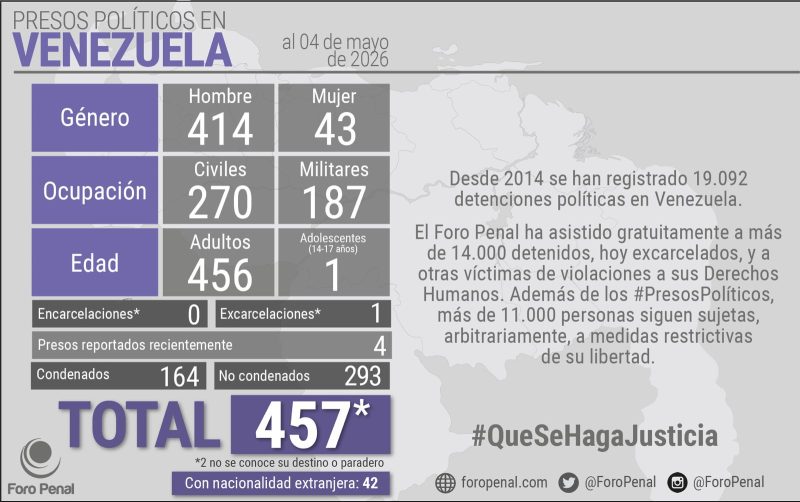
Foro Penal’s latest balance states that, as of early May 2026, there are 457 people detained in Venezuela whom the NGO classifies as political prisoners, and both opposition and government-aligned coverage generally reproduce this headline figure and its breakdown. Reports on both sides acknowledge Foro Penal as the source, repeating that 414 of those detainees are men and 43 are women, that 270 are civilians and 187 are military personnel, and that 42 are foreigners. There is also broad agreement that a majority of these detainees have not been convicted, with 293 cases still lacking final judgment, and that many face prolonged judicial delays. Outlets across the spectrum note Foro Penal’s historical figures, including more than 19,000 politically motivated detentions since 2014 and over 14,000 assisted releases.
Shared context across opposition and government-aligned reporting recognizes Foro Penal as a longstanding Venezuelan human rights NGO that has systematically documented detentions linked to protests, dissent, and alleged conspiracies since at least 2014. Both sides refer to the broader situation as part of Venezuela’s protracted political and institutional crisis, with recurring waves of arrests following demonstrations, alleged coup plots, or electoral tensions. They also converge in situating the issue within an ongoing international scrutiny of Venezuela’s justice system, referencing dialogues or negotiations where prisoner releases have figured as confidence-building measures. There is implicit agreement that the prison and court systems are overloaded, that cases often move slowly, and that any future political agreements or reforms are likely to hinge in part on how these detainees’ cases are resolved.
Areas of disagreement
Definition and labeling. Opposition outlets adopt Foro Penal’s terminology without qualification, consistently referring to all 457 detainees as political prisoners and framing them as jailed for dissent, protest, or opposition activity. Government-aligned coverage, while citing the same numbers, tends to describe the detainees more generically as persons deprived of liberty, or emphasizes that many are accused of crimes such as conspiracy, terrorism, or military rebellion, thus questioning the blanket label of political prisoners. Opposition reports treat the foreign detainees as further evidence of criminalization of solidarity and transnational activism, whereas pro-government outlets underscore that some foreigners are allegedly involved in destabilization or espionage.
Responsibility and legality. Opposition media portray the detentions as the result of systematic repression directed by the executive branch, arguing that security bodies and courts are used to neutralize opponents and instill fear. Government-aligned outlets instead stress that the arrests follow legal procedures initiated by prosecutors and judges who are depicted as acting independently against threats to national security. While opposition sources highlight the high number of detainees without conviction as proof of arbitrary and abusive practices, official-leaning coverage frames procedural delays as administrative or structural issues in a strained judiciary, not as deliberate policy.
Human rights and international pressure. Opposition coverage foregrounds accusations from international NGOs, foreign governments, and UN mechanisms that denounce torture, due process violations, and the use of political prisoners as bargaining chips in negotiations. Government-aligned media downplay or contest these claims, either omitting the most severe allegations or presenting them as part of a geopolitical campaign aimed at delegitimizing Venezuelan institutions. Opposition outlets link Foro Penal’s data to calls for stronger sanctions or conditionality on international agreements, whereas pro-government sources point to prisoner releases and dialogue processes as evidence that the state is responsive and sovereign in handling these cases.
Political narrative and reform prospects. Opposition sources use the 457 figure to argue that there has been no meaningful democratization or judicial reform, asserting that each new negotiation cycle produces only partial releases while new arrests replenish the numbers. Government-aligned coverage, by contrast, often situates the statistics within a narrative of gradual normalization, highlighting previous mass releases, the thousands assisted by Foro Penal who are no longer detained, and ongoing dialogue as signs of progress. For opposition media, the persistence of hundreds of political prisoners invalidates electoral and institutional processes; for pro-government outlets, the existence of detainees is framed as compatible with a country defending itself against coups and terrorism while still pursuing selective reforms.
In summary, opposition coverage tends to treat Foro Penal’s figures as incontrovertible proof of systematic political repression and an unreformed authoritarian justice system, while government-aligned coverage tends to reframe the same data as evidence of isolated or legally justified cases within a broader narrative of security, sovereignty, and gradual institutional adjustment.