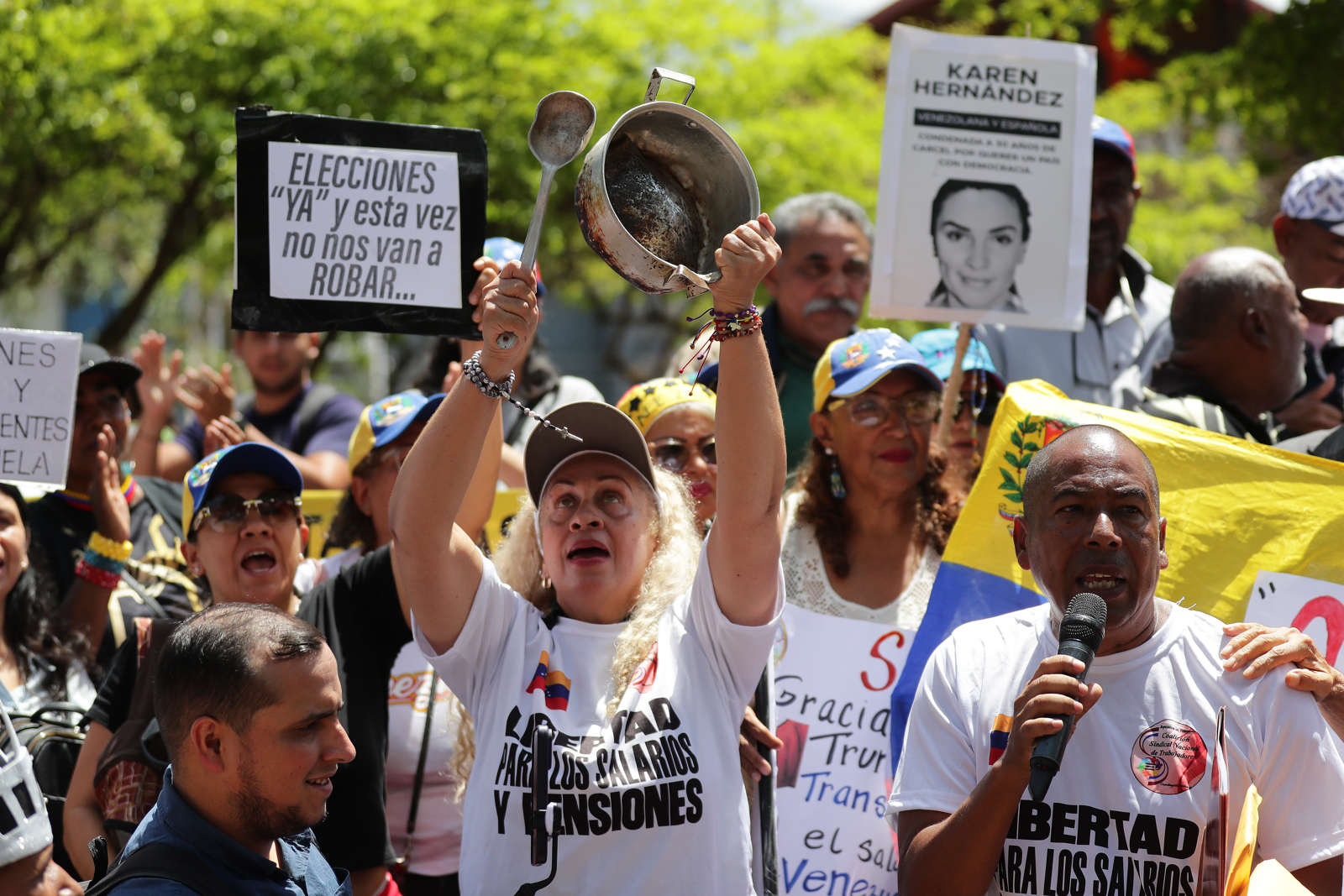
Union leaders and workers from various sectors in Venezuela gathered outside the United States Embassy in Caracas to protest what they describe as a deep salary crisis and persecution of workers. Across outlets, it is reported that organizers denounce the freezing of the official minimum wage and the government’s practice of using non-salary bonuses that do not count toward social benefits, pensions, or severance pay. Protesters delivered a written document to embassy officials, and coverage from both sides notes that the action is part of a broader cycle of labor and political mobilizations, with plans for a larger national march on June 3 in defense of democratic guarantees and workers’ rights.
Shared context across sources emphasizes that Venezuela’s prolonged economic crisis, high inflation, and the erosion of formal wages have severely reduced workers’ purchasing power, leading unions to frame the current arrangement of bonuses instead of salary increases as a violation of existing labor laws. Reports agree that the protest is directed symbolically at the U.S. Embassy but substantively at Venezuelan state institutions, which unions accuse of failing to uphold constitutional protections for labor and democratic participation, including fair elections and the rule of law. Coverage converges on the idea that union activism has become intertwined with broader human rights concerns, such as the call for the release of political prisoners and demands for institutional reforms to restore legal guarantees for workers and citizens alike.
Areas of disagreement
Framing of the protest’s target. Opposition-aligned sources tend to portray the demonstration as a direct challenge to the Maduro government and its economic policies, emphasizing that union leaders are appealing to international actors only because domestic institutions are unresponsive or co-opted. Government-aligned outlets, while acknowledging the protest at the U.S. Embassy, more often stress the embassy as the formal destination of grievances and may frame it as part of a dialogue with foreign powers whose sanctions they say aggravate the crisis. Opposition coverage thus highlights state responsibility as primary, whereas pro-government narratives distribute blame between internal policy and external pressure.
Responsibility for the salary crisis. Opposition-aligned media typically attribute the wage collapse and reliance on bonuses to systemic mismanagement, corruption, and the government’s refusal to implement structural reforms or respect collective bargaining. Government-aligned coverage is more likely to mention the use of bonuses as a pragmatic, anti-inflation tool in a constrained economy, often invoking sanctions and economic warfare as key obstacles to raising formal wages. While both sides describe workers’ hardship, opposition outlets present it as almost entirely domestically generated, whereas government-aligned outlets frame it as the outcome of both internal limits and external aggression.
Political dimension of union demands. Opposition-aligned sources usually underscore the explicitly political content of the unions’ petition to the U.S. Embassy, stressing demands for free and fair elections, questioning Delcy Rodríguez’s legitimacy, and calling for the release of political prisoners as evidence that labor and opposition agendas now converge. Government-aligned outlets, when they mention these points, tend to downplay the challenge to the executive’s legitimacy and may cast appeals for foreign pressure on elections as interference in sovereignty or as part of an opposition strategy to internationalize internal disputes. As a result, opposition coverage elevates the protest as a democratic turning point, while pro-government narratives more often recast it as politicized or externally influenced.
Role of international actors. Opposition-aligned media generally describe the unions’ approach to the U.S. Embassy as a lawful and necessary attempt to enlist international support for labor rights, democratic norms, and human rights in a context where domestic remedies are seen as blocked. Government-aligned outlets, by contrast, are prone to question or criticize the idea of asking the United States—often portrayed as the architect of sanctions and economic pressure—for help, suggesting this undermines national sovereignty and exacerbates economic woes. Thus, opposition narratives normalize and legitimize the embassy as a venue for pressure, while government-aligned narratives problematize or delegitimize that international recourse.
In summary, opposition coverage tends to spotlight the protest as a direct indictment of the Maduro government’s economic and political record and a legitimate appeal to international allies, while government-aligned coverage tends to dilute or reframe that indictment by stressing external factors, sovereignty concerns, and the controversial role of the United States.