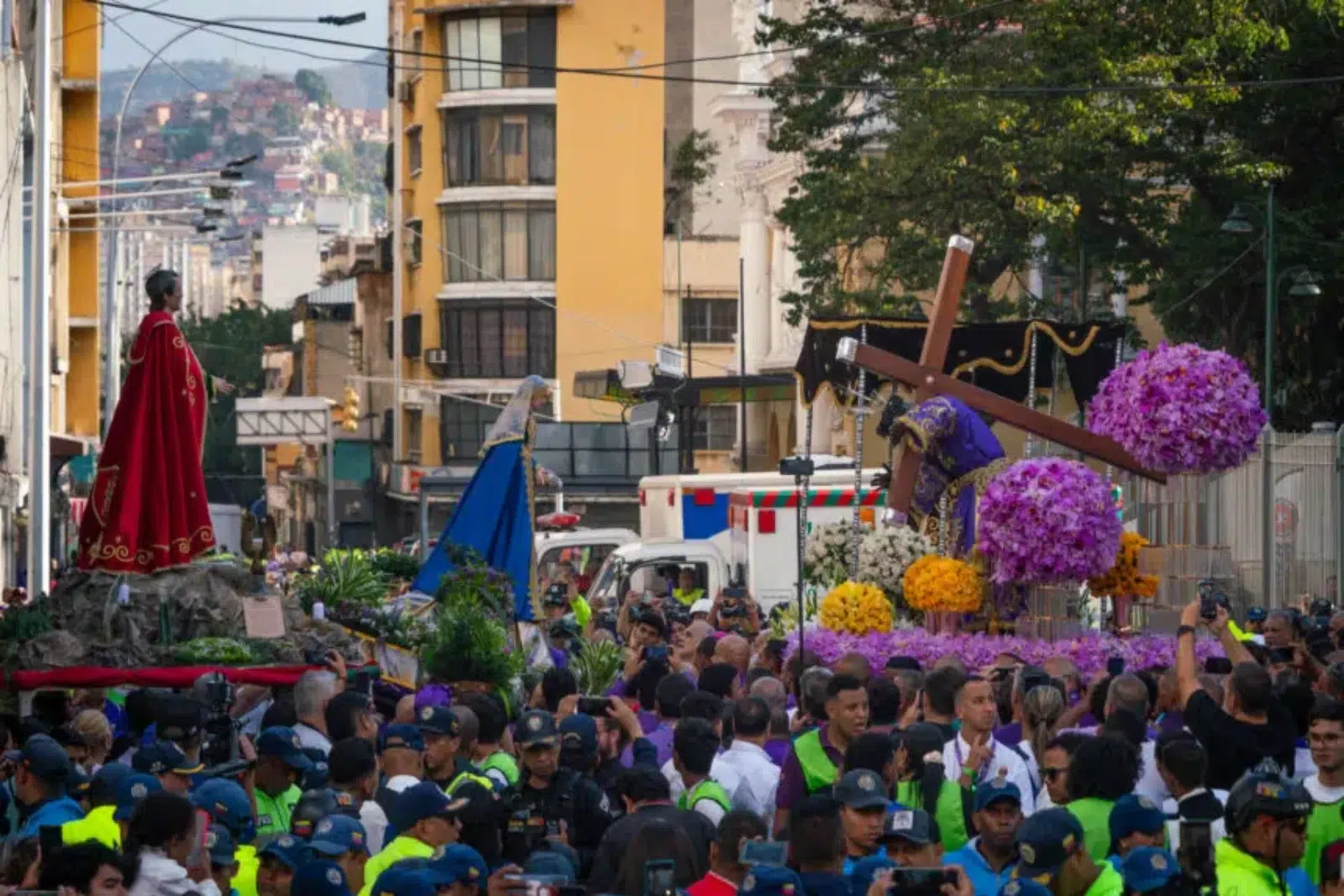
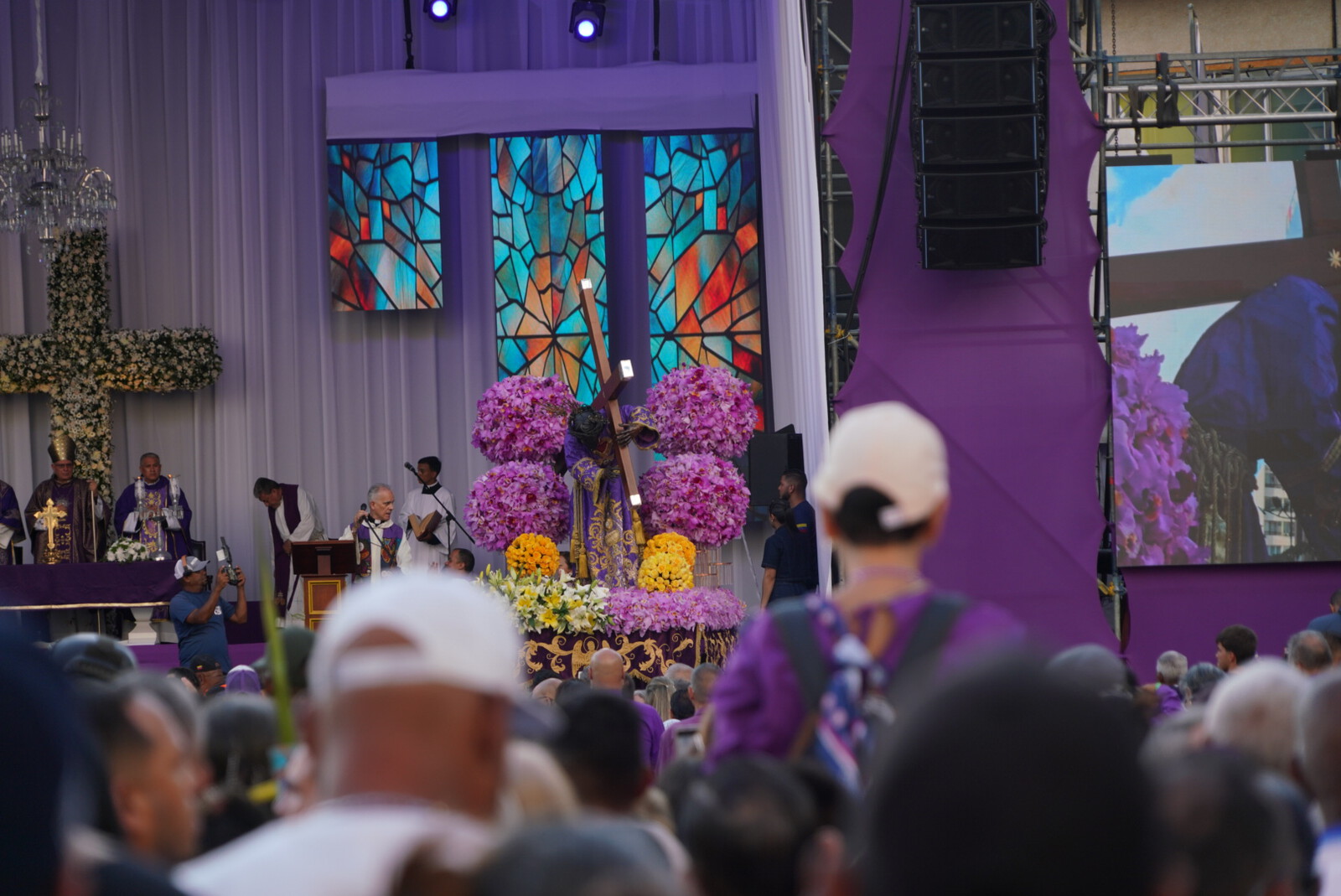
Hundreds of faithful Catholics participated in the Nazareno de San Pablo procession in Caracas, beginning with a Mass officiated by Archbishop Raúl Biord Castillo in Diego Ibarra square and then following a roughly five‑kilometer route through central streets of the capital. The event took place on April 1 and featured the traditional image of the Nazareno carried through various key locations, with the route and plazas decorated with thousands of purple orchids and yellow flowers as devotees accompanied the image in an atmosphere repeatedly described as joyful, orderly, and devout.
Across the spectrum, coverage emphasizes that the Nazareno de San Pablo devotion is a centuries‑old Holy Week tradition in Caracas, with documented origins around 1697 and links to a historical epidemic in colonial times. Reports also agree that the figure has long been intertwined with Venezuela’s broader historical narrative, including references to the early independence period, and that the procession combines liturgical acts—such as Masses, prayers, and blessings—with popular religious expressions, including petitions for the sick, for reconciliation, and for those suffering social and political conflict.
Areas of disagreement
Religious meaning versus political subtext. Government-aligned outlets frame the Nazareno de San Pablo procession primarily as a manifestation of spiritual renewal, emphasizing joy, devotion, tradition, and unity, while either briefly or neutrally mentioning any prayers related to the country’s political situation. Opposition-aligned sources would be more inclined to stress the political dimension of those prayers, particularly intercessions for political prisoners and calls to overcome hate, presenting them as subtle critiques of the current authorities. In this lens, government-aligned media portray the religious event as largely separate from political contention, whereas opposition media would interpret the same religious language as a coded reflection of ongoing grievances.
Portrayal of the state’s role. Government-aligned coverage highlights institutional support for the procession, implicitly crediting public authorities and security bodies for guaranteeing order, enabling large crowds to participate safely, and showcasing the event as a symbol of social peace. Opposition-leaning accounts would more likely question this framing, suggesting that high religious turnout reflects a search for refuge amid economic and political hardship and that state presence is as much about control and image management as genuine support. Thus, state institutions are cast by government-aligned outlets as facilitators of faith and tradition, while opposition narratives would position them as politically self-interested actors surrounding a sacred event.
Social climate and underlying problems. In government-aligned reporting, the social environment around the procession is depicted as harmonious, with emphasis on hope, reconciliation, and community, and little focus on shortages, insecurity, or rights concerns that might affect attendees’ daily lives. Opposition outlets would be more prone to juxtapose the fervor of the procession with continuing crises in health, services, and governance, arguing that the public’s piety coexists with deep frustration and material deprivation. As a result, the same scenes of crowded streets and prayer are portrayed either as evidence of a resilient, hopeful nation or as a poignant contrast to unresolved structural problems.
Historical symbolism and present-day implications. Government-aligned media underscore the colonial-era epidemic and early independence references mainly to reinforce a narrative of national continuity, resilience, and divine protection over Venezuela. Opposition voices would be more likely to draw parallels between past calamities and current political and economic instability, implying that today’s leaders have not lived up to the historical struggle for freedom and dignity associated with the Nazareno’s legend. Consequently, the figure’s historical symbolism is used either to buttress a unifying patriotic story or to frame an implicit critique of the country’s present trajectory.
In summary, opposition coverage tends to read the Nazareno de San Pablo procession through the lens of current political tensions and unresolved crises, while government-aligned coverage tends to emphasize spiritual devotion, national tradition, and institutional normalcy around the event.