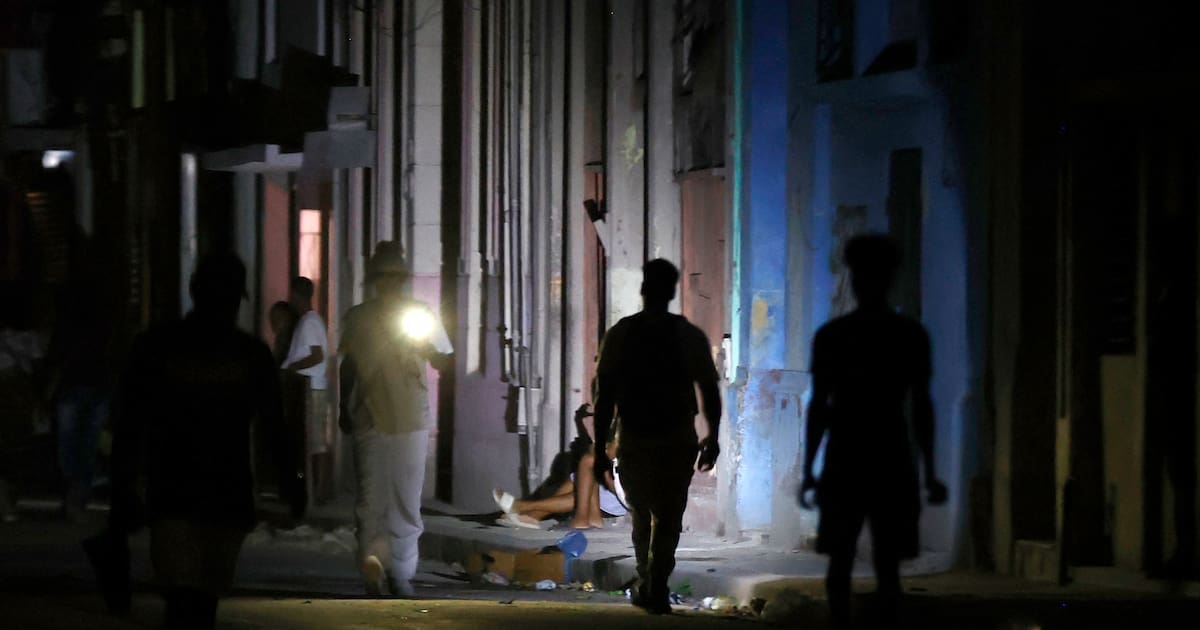
Cuban and international outlets across the spectrum report that Cuba has suffered a near-total or total blackout following a collapse or total disconnection of the National Electric (Electroenergetic) System, affecting roughly 9–10 million people across most of the island. This is widely described as the sixth nationwide outage in about 18 months, with power loss extending for many hours—close to 20 hours in some areas—and only a small fraction of the country’s 16 thermoelectric units operating during the early stages of recovery. Both opposition and government-aligned sources agree that the blackout coincided with or followed an early-morning magnitude 6 offshore earthquake felt in eastern provinces, though the quake is not presented as the primary cause. They also concur that the outage disrupted not only electricity but, in many areas, telephone and internet services, and that officials have activated recovery protocols whose step-by-step reconnection process can be technically complex and time-consuming.
Both sides agree that Cuba is experiencing a deep, ongoing energy crisis rooted in dependence on aging thermoelectric plants, chronic fuel shortages, and fragile grid infrastructure that make the system vulnerable to nationwide failures. Opposition and government-aligned reports alike note that the country has faced repeated national blackouts, prolonged daily power cuts, and drastic energy-saving measures that have crippled the already weak economy and increased social unrest. They also converge on the role of external pressure—especially U.S. sanctions and disruptions to oil supplies—in tightening fuel availability, while acknowledging that restoring reliability would require investments of billions of dollars well beyond Cuba’s current financial capacity. Across the coverage, there is shared recognition that institutional actors such as the Ministry of Energy and Mines and the National Electric System operator are central to both investigating the failure and managing a slow, technically constrained restoration process.
Areas of disagreement
Responsibility and blame. Opposition outlets emphasize long-term government mismanagement, lack of maintenance, and failed planning as the core reasons the system is so fragile, treating U.S. sanctions and fuel problems as aggravating but not primary causes. Government-aligned coverage foregrounds U.S. sanctions, the reduction of oil shipments from Venezuela, and threats against other fuel suppliers as the decisive drivers of the crisis, presenting the blackout as a result of external economic asphyxiation. While opposition pieces stress that authorities have had years to diversify energy sources and modernize plants but failed, government-aligned reports frame Cuba as a besieged country doing its best under hostile conditions.
Characterization of the crisis and social unrest. Opposition sources highlight the blackout as a tipping point in a broader governance and legitimacy crisis, linking it directly to mounting protests, frustration, and the possibility of wider social explosions. Government-aligned outlets acknowledge that the power cuts are deepening hardship and fueling discontent but tend to describe unrest in more muted, general terms, avoiding detailed accounts of protests or explicit political criticism. The opposition narrative portrays the outages as emblematic of systemic state failure, whereas government-oriented reporting presents them as painful but temporary shocks within a resilient social model under siege.
Government response and transparency. Opposition coverage frequently portrays the official response as slow, opaque, and reactive, noting that authorities provide limited technical detail and shifting explanations while downplaying the scale and duration of the damage. Government-aligned stories stress the rapid activation of recovery protocols, ongoing investigations by the Ministry of Energy and Mines, and the technical complexity of restarting the grid, framing these as evidence of professional and committed management. For opposition outlets, references to protocols underscore bureaucratic inertia and lack of accountability, while for government-aligned media they illustrate responsible crisis handling in a constrained environment.
Role of structural versus external factors. Opposition media place strong emphasis on structural decay—obsolete thermoelectric plants, years of insufficient investment, and poor diversification of the energy matrix—as the dominant explanation for the blackout and its recurrence. Government-aligned outlets mention aging infrastructure but integrate it into a narrative where external constraints, especially sanctions and disrupted oil flows, are the primary obstacles to modernization and reliability. Consequently, opposition coverage suggests that even with sanctions relief, systemic reforms and new governance would be necessary, while government-aligned narratives imply that easing external pressure and securing fuel supplies would largely stabilize the system.
In summary, opposition coverage tends to frame the blackout as the predictable outcome of systemic mismanagement and decaying infrastructure that is driving a deeper political and social crisis, while government-aligned coverage tends to attribute the event chiefly to U.S. sanctions and external fuel constraints, emphasizing government efforts and resilience while downplaying internal culpability.