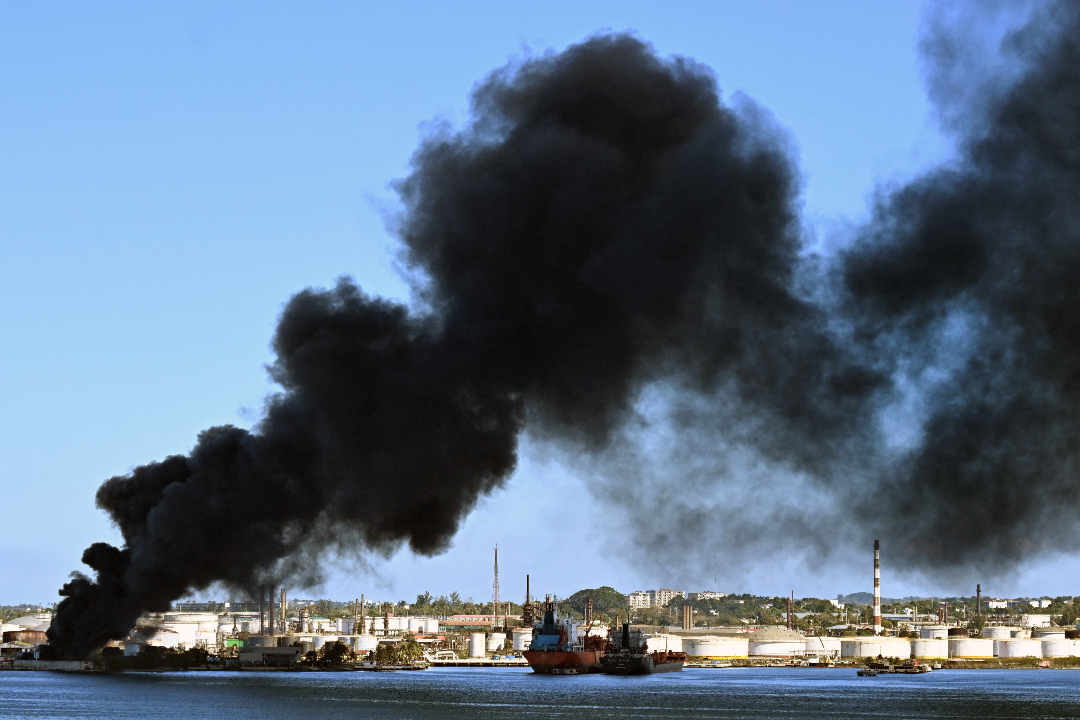
A fire broke out at the Ñico López oil refinery in Havana, in a storage area of the facility, sending a large column of smoke and visible flames over the capital and across Havana Bay. Both opposition and government-aligned outlets report that the blaze began on Friday and was subsequently brought under control by Cuban authorities, with officials indicating that firefighting efforts contained the incident on-site. The coverage agrees that authorities have not yet provided detailed information on the cause of the fire or confirmed the existence of casualties, and that an official investigation has been opened to determine what happened.
Across both opposition and government-aligned reporting, the Ñico López refinery is consistently framed as a critical energy and fuel infrastructure asset for Cuba, located near key port facilities in Havana Bay. Both sides acknowledge that the incident occurs amid a broader, severe energy crisis in the country, shaped by declining oil supplies from traditional partners and external economic pressures. They also agree that the fire heightens concerns about the resilience and safety of Cuba’s aging energy infrastructure, and that the outcome of the official investigation could have implications for future reforms or safety measures in the energy and industrial sectors.
Points of Contention
Responsibility and blame. Opposition outlets emphasize the lack of transparency and suggest that chronic mismanagement, underinvestment, and poor maintenance by the Cuban state likely contributed to the fire, even if no official cause has been disclosed. Government-aligned media stress that the cause remains under formal investigation by the Ministry of Energy and Mines, avoiding premature attribution of fault. While opposition narratives lean toward systemic state responsibility as a working assumption, government-aligned coverage frames the event as an industrial accident whose specific origins should not be speculated on until authorities conclude their technical inquiry.
Transparency and information flow. Opposition coverage underscores the absence of concrete data on victims, damage levels, or detailed timelines, portraying the government’s communication as delayed, minimal, and tightly controlled. Government-aligned sources present the available information as timely and sufficient, highlighting official statements that the fire is under control and that an investigation is underway. Opposition media interpret the information gaps as part of a broader pattern of opacity in handling industrial and safety incidents, whereas state-aligned outlets depict the communication as responsible and measured, focused on avoiding rumors and panic.
Broader political and economic framing. Opposition outlets connect the fire to longstanding structural failures in Cuba’s socialist economic model, arguing that infrastructure decay, fuel shortages, and repeated accidents reflect systemic crisis and governance failure. Government-aligned media instead situate the fire within the context of external pressures, emphasizing the impact of dwindling oil shipments from Venezuela and U.S. trade and financial restrictions on Cuba’s energy system. Where opposition narratives use the incident as further evidence of domestic policy failure and institutional stagnation, government-aligned reporting uses it to underscore Cuba’s vulnerability to external constraints and the resilience of state services under difficult conditions.
Risk and public safety narrative. Opposition coverage highlights the visible smoke and proximity to populated areas and port activity to stress the potential danger to residents and the environment, implying that the public is routinely exposed to elevated risks due to outdated facilities. Government-aligned sources acknowledge the dramatic visuals but emphasize that the fire was contained, that emergency protocols worked, and that authorities maintained control of the situation. Thus, opposition reporting frames the event as another warning sign of systemic safety peril, whereas government-aligned coverage frames it as a challenging but effectively managed emergency.
In summary, opposition coverage tends to use the refinery fire to highlight state mismanagement, opacity, and structural crisis within Cuba’s energy system, while government-aligned coverage tends to portray it as a controlled industrial accident occurring under severe external constraints, emphasizing institutional response and ongoing official investigations.