economy
May 2, 2026
The BCV and the surrender of institutionalism
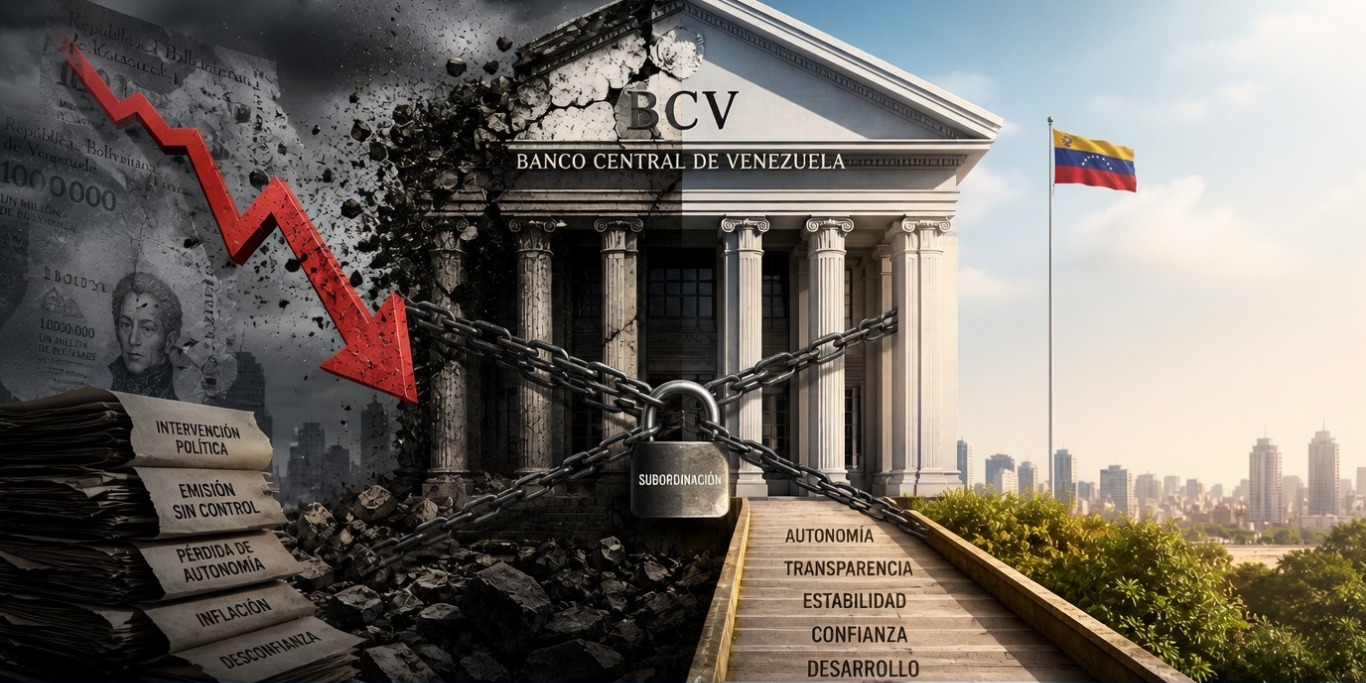
We can see Venezuela's recent economic history through what has happened to its currency. For those of us who closely follow financial dynamics, not as cold macroeconomic data, but as a vital element of a society, the current state of the Central Bank of Venezuela (BCV) is something much more serious than a technical crisis. It represents the total surrender of institutionalism to political power. After almost three decades of transformations, the issuing institution has ceased to be the guardian of the value of our work, becoming a passive appendix, an executing arm of the National Executive whose functionality as a monetary authority is, today, practically nil.
TL;DR
- The Central Bank of Venezuela (BCV) has transformed from a technical institution into a political tool, functioning as a passive appendix of the National Executive.
- Over 28 years, legal reforms and governance capture weakened the BCV, culminating in the ability for the Executive to remove directors discretionarily and to finance government spending.
- Key reforms in 2005 and 2010 allowed the BCV to transfer 'excess' reserves and buy PDVSA bonds, leading to primary currency issuance and hyperinflation.
- A recovery plan requires international mediation for a new BCV board, legislative reforms to guarantee autonomy, and a roadmap prohibiting public financing, ensuring statistical transparency, and reducing legal reserve requirements.
- Restoring the BCV's autonomy and technical function is crucial for attracting investment and achieving a prosperous future for Venezuela.